Maths
Intent
At Farncombe we believe that all children are able to succeed mathematically, and that one of our main priorities as maths teachers is to find ways of presenting, scaffolding and
teaching concepts in such a way that every child will achieve. We want to inspire our children with the wonder of maths, so that they are engaged and motivated. Our children
will be taught to be confident, successful and proficient mathematicians who can apply their maths to other contexts and situations.
The National Curriculum for Mathematics aims to ensure that all pupils:
-
Become fluent in the fundamentals of mathematics so that they can develop their conceptual understanding and the ability to recall and apply knowledge rapidly and accurately.
-
Reason mathematically, including being able to develop an argument, justification or proof using mathematical language.
-
Solve problems by applying their mathematics to a variety of problems, including breaking them down into a series of smaller steps, and preserving in seeking solutions.
Implementation
At Farncombe, we follow White Rose Scheme of Learning. Many of the principles of mastery underpin this scheme and our teaching. A whole class teaching approach is
adopted, keeping the class working together and giving all pupils the chance to work on fluency, reasoning and problem solving tasks. Children are exposed to multiple
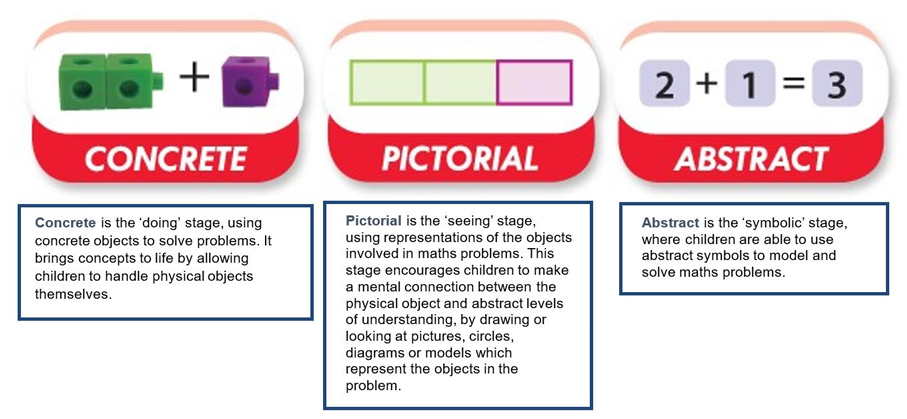
representations of a concept, using concrete, pictorial and abstract representations to support the children’s learning. Opportunities are also provided for all pupils to revisit and
reinforce learning, including key concepts and from previous years, to help them truly develop their understanding and mastery.
In EYFS, children work towards the Early Learning Goal for Number and Shape, Space and Measure. The White Rose materials are used where appropriate which a strong focus on Number, ensuring children have a solid understanding of the numbers 1-10 and then the teen numbers. EYFS mathematics is taught through a combination of adult led activities, independent activities and child-initiated play. Materials from the NCETM are used to inspire and consolidate.
In the Key Stage One curriculum, the children build on their EYFS knowledge and focuses on four areas across the course of the year: number, measurement, geometry and statistics.
In Year 1 children will cover number and place value for numbers up to 50, addition and subtraction within 20, recognising 2D and 3D shapes, length and height, weight and volume, counting in groups of 2, 5 and 10, halves and quarters, telling the time(o’clock and half past) and recognising and adding coins.
In Year 2 will continue to build on, deepen and secure their knowledge by covering number and place value for the numbers to 100, develop a variety of methods to solve addition and subtraction within 100, multiplication and division for the numbers in the 2, 3, 5 and 10 times tables, money including coins and notes, statistics, measurement, properties of 2D and 3D shapes, fractions, time (quarter past/to, 5 minute intervals). Children will develop a range of problem solving methods and be able to select the most efficient method to find the possible answers.
Mathematical language is crucial and modelled by teachers with the high expectation for children to use accurate vocabulary to enable them to embed the understanding and key concepts. Key vocabulary is identified at the start of the unit and recapped at the start of lessons, which is displayed on the class working wall.
Throughout the lesson, multiple opportunities for ‘Assessment for Learning’ ensure that children have the chance to assess their learning and the teacher is able to identify next
steps as well as additional intervention that may be needed. At the end of each unit of work, each child completes an end of unit check. This covers a range of concepts that have been covered to demonstrate their progress and understanding they have made over the unit.
Children are assessed formally on a half termly basis; this assessment is based on everything that has been covered so far within the term.
In order to increase fluency of arithmetic skills focusing repetition of the four basic operations children take part in a 15 minute ‘Mighty Maths’ sessions to practise and embed
these skills.
If you were to walk into a Maths lesson at Farncombe you would see:
-
Opportunities for children to recap previous learning.
-
Engaged children working with concrete resources.
-
Key vocabulary being modelled by adults and the expectation of children to use the correct mathematical vocabulary when explaining their understanding.
-
Children exploring concrete, pictorial and abstract approaches to help understand a concept and deepen their understanding.
-
Children being encouraged to explain how and why they have solved a calculation or problem.
-
Adults working with a carefully, selected guided group to ensure progress.
-
Adults using questioning to support and challenge children’s learning.